quarta-feira, 26 de setembro de 2012
Jordan 191
O Jordan 191 é um dos carros mais belos da história da Fórmula 1, projetado por Gary Anderson tinha linhas harmônicas e tons de verde bem interessantes que faziam alusão à origem irlandesa do time. Kit Tamiya na escala 1/20. One of the many Formula One Racing teams, Jordan Grand Prix, grew out of the Eddie Jordan Racing, one of the most successful international motorsport racing teams of the 1980’s. Founded by Eddie Jordan in 1980, the team quickly established itself as a major force in Formula 3 and Formula 3000 Championship. At the beginning of the 1990 racing season, Eddie announced that he planned to enter Formula One Racing starting in 1991. His entry resulted in one of the most esthetic and potent racing machines seen during the 1991 Formula One Grand Prix season. The car was designed by the very talented Gary Anderson, and designated the “Jordan 191”. The racer incorporated an anhedral type of front wing for optimum aerodynamic performance at the track. The monocoque chassis is full of carbon fiber composite construction, designed in-house using the latest Computer Assisted Design (CAD) facilities. The rear under cowling uses a very distinctive twin-tunnel shaped defuser, effective for additional downforce. A new and highly realiable Ford V-8 HB powerplant is matched to Jordan’s originally designed in-house gear box. The stopping power for this awesome racing machine utilizes the AP racing brake system with 6-piston calipers on the front and 4-piston calipers at the rear, matched to HITCO made carbon fiber discs and pads. With the driving skills of Andrea de Cesaris and Bertrand Gachot, the Jordan 191 racing machine had the right ingredients for a great firts year, and displayed brilliant performance throughout the 1991 Grand Prix season. Tamiya kit, 1/20 scale.
quinta-feira, 20 de setembro de 2012
Embassy Hill GH2
O GH-2, foi o primeiro formula 1 da equipe Hill, foi projetado por Andy Smallman para a temporada de 1976. O projetista criou novas idéias usando elementos básicos dos carros rivais, O GH-2 tem o nariz em cunha do Lotus 72, o chassis trapezoidal, para diminuir a resistência do ar, usado pelo carro de F-Indy de Parnelli Jones(ambas idéias de Maurice Phillipe); O chassis trapezoidal foi adaptado por Gordon Murray a partir do Brabham BT-42 até o BT-46. Os radiadores atrás das rodas dianteiras foram projetados por Mauro Forghieri para a Ferrari 312B3 e modelos T, o castelo alto foi visto pela primeira vez no Hesketh 308C de Harvey Postlethwaite no final da temporada 1975. A asa traseira é similar à Lotus 72 original que tinha 3 elementos, o GH-2 tem dois elementos. Usando estas idéias, Andy Smallman criou um único e bonito formula 1, promissor para a temporada 1976. O GH-2 era equipado com motor Ford Cosworth DFV V-8 de 3 litros e caixa de câmbio Hewland. Em novembro de 1975, para testar em melhores condições climáticas, a equipe Hill foi ao circuito Paul Ricard no sul da França, após os testes no retorno para a Inglaterra, Graham Hill, Tony Brise, Andy Smallman e outros três membros da equipe morreram em um acidente aéreo. A equipe fechou e o GH-2 nunca participou de uma corrida. Kit Iritani na escala 1/20. The GH-2, the first selfmade Hill Formula 1, was designed by Andy Smallman for the season 1976. The designer created new exciting ideas using basic elements seem at rival teams cars, GH-2 had got the flat nose of the Lotus 72, trapeziform monocoque chassi for reducing air resistance used by Indy car Parnelli Jones(both ideas invented by Maurice Phillippe); the trapeziform chassi was adopted by Gordon Murray for the Brabham BT-42 to 46 types. The radiators behind front wheels was designed by Mauro Forghieri for his Ferrari 312 B3 and T models, the high cockpit cover was seem for the first time at Harvey Postlethwaite’s Hesketh 308 C in the end of 1975. At least the rear wing is similar to Lotus 72 original version; GH-2 had two elements of three ones at Lotus. Using these ideas, Andy Smallman created a unique and beautiful looking car being very promising for the 1976. The GH-2 was fitted out by Ford Cosworth DFV V-8 3 liter engine and Hewland Gearbox. The Hill Team had gone to Paul Ricard circuit in the south of France for testing under better weather conditions with Tony Brise behind the Wheel at the end of november 1975. When returning to England from that testing session, Graham Hill, Tony Brise, Andy Smallman and three others members were killed in an aircraft accident. The team closed down, GH-2 was never driven in a race. Iritani kit, 1/20th scale.
RAM Williams FW07
Williams FW07 da equipe RAM, pilotado por Rupert Keegan na Holanda em 1980, kit Tamiya restaurado, decais Studio27.
terça-feira, 4 de setembro de 2012
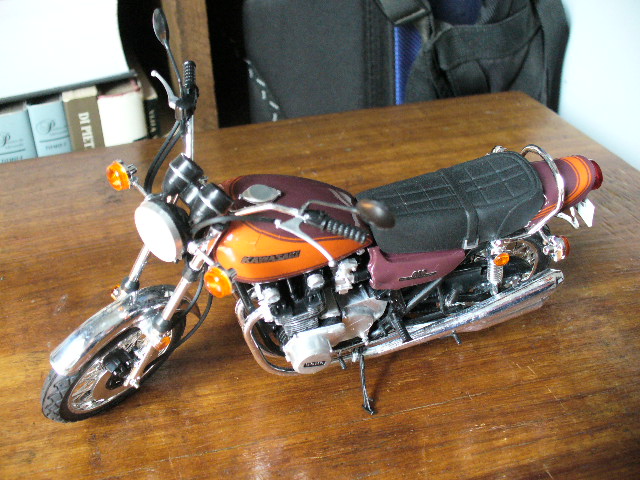
Kawasaki Z2 Road Star
Kit terminado no final de semana, Kawasaki Z2 Road Star de 1973, kit da Aoshima na escala 1/12. In December 1972, Kawasaki held a press conference in Tokyo and invited guests from 17 companies in the motorcycle industry, reporters from magazines and newspapers. At the conference, a new model 750RS Z2, was introduced as a brother model for the Japanese market in 1973.
The Z2 is very similar to the Z1 with the only difference being the smaller engine. The new 746cc DOHC engine was built with newly designed pistons and crankshaft parts to give it a feel similar to the Z1's 900cc engine. The maximum Z2 horse power was 69ps at 9,000rpm with a maximum speed of 190km/h. Sale of the Z2 were 10% higher than their competitors' 750cc class motorcycles.
The 900cc class body size and the DOHC engine attracted Japanese riders all at once because motorcycle equipped with DOHC engine had not existed in Japan prior to the Z2.
During the first two years of production, Kawasaki built 80,000 Z1 and Z2 motorcycles, and the sales of these models established Kawasaki's reputation as a heavy weight motorcycle manufacturer.
The side panel badges were identical to the 900 versions apart from the cc size, and of course it had a KPH speedo with a "red line" of 80KPH. Anything more than 80kph and a switch under the fuel tank is tripped and a warning light fitted on top of the headlight comes on. The only other cosmetic change would be for the eagle eyed, that being a 42 tooth rear sprocket in place of 35 tooth Z1 item. Although this motorcycle is most commonly referred to as Z2, it is perfectly acceptable to refer to it as 750-RS. "RS" stood for "Road Star" or "Roadster". Aoshima kit, 1/12th scale.
sábado, 25 de agosto de 2012
Yamaha XV1600
Terminamos mais um kit na semana que passou, uma moto muito bonita da Yamaha, a XV1600 "Roadstar", kit Tamiya na escala 1/12. Another finished kit, the Yamaha XV1600 Roadstar. The creative designers at Yamaha unlocked their rebellioys spirit, and brought a bike that has come to be known as the ultimate streetfighter of the big-displacement cruiser class: the Road Star. This class of bike was originally designed for cruising down the spacious highways of America, but was since caught the interest of bike fans worldwide. In 1999, Yamaha redefined the standard of the cruiser class, injecting the Road Star with a powerful twin-cam, air-cooled, 98 cubic-inch, pushrod V-twin engine. This monster of a powerplant displays a massive maximum torque of 12.9kg-m at 2000 rpm, blowing away that of other machines in its class. From the moment the thumb starter is pressed, the rider is put in command of the seemingly endeless, yet ultra-smooth output. The 20kg crank weight and high rigidity of the engine mounting serve to transmit the purring vibration of the engine directly to the rider, just one more joy this machine provides. The front suspension adopts a rigid, telescopic type and the rear shock is tucked out of sight for that classic, hardtail look. This balance, in addition to providing a smooth ride, ensures nimble maneuvering on winding roads. The style of the Road Star speaks for itself. Low-slung lines blended with the liberal use of chrome make this cruiser indisputably attractive. With ample legroom, easy-to-reach handlebars, and a plush saddle, the Road Star’s ergonimics alone make it irresistible to even the most scrutinizing of cruiser enthusiasts. Tamiya kit, 1/12th scale.
quinta-feira, 2 de agosto de 2012
Sauber C30
Mais um kit Fujimi finalizado, agora o Sauber C30 pilotado por Kamui Kobayashi em Suzuka 2011, a escala é 1/20 como de costume (peço desculpas pelas péssimas fotos nesta postagem e nas últimas atrás, devo ter desconfigurado a câmera nos últimos meses e não me dei conta). Another Fujimi's kit finished, Sauber C30 drove by Kamui Kobayashi in Suzuka, 1/20th scale as usual.
terça-feira, 3 de julho de 2012
Honda NXR 750
Postagem rápida mostrando o último modelo terminado, a Honda vencedora do Paris-Dakar de 1986, kit antigo mas bem simpático, escala 1/12. Competitors in the eighth Paris-Dakar Rally headed south into wilds of the Sahara desert, struggling over the dunes in search of glory in this torturing rally that lasts more than 20 days and approximately 14,000km. Automotive manufacters taking part in this renown rally concentrate on reability of the machine, which is more of an asset than speed. Honda will remember the 1986 Paris –Dakar Rally for their victory in the two wheel category with the NXR 750 desert racer. Cyril Neveu came through the sea of sand riding on this superlative hi-tech rally machine, to reach the exotic shores of Senegal, making history as the first ever liquid cooled engine powered motocycle to win this rally. The history making four valve, SOHC, V twin cylinder liquid cooled engine has a displacement of 779cc and produces more than 70 horse power. This racer was developed exclusively for the Paris-Dakar Rally by the Honda Racing Corporation, better known as HRC, who are renown for producing many record breaking/legend making racers. Their painstaking endeavors are apparent in the NXR´s slim, low center of gravity concept configuration. The dual headlights and cowling are rarely seen on these off road type motocycles and they stood out as it sped through the heat waves of the Sahara. Tamiya kit, 1/12th scale.
Assinar:
Postagens (Atom)